

O Come Emmanuel: approaching Advent with the O Antiphons
- kafjowitt
- Dec 11, 2025
- 8 min read
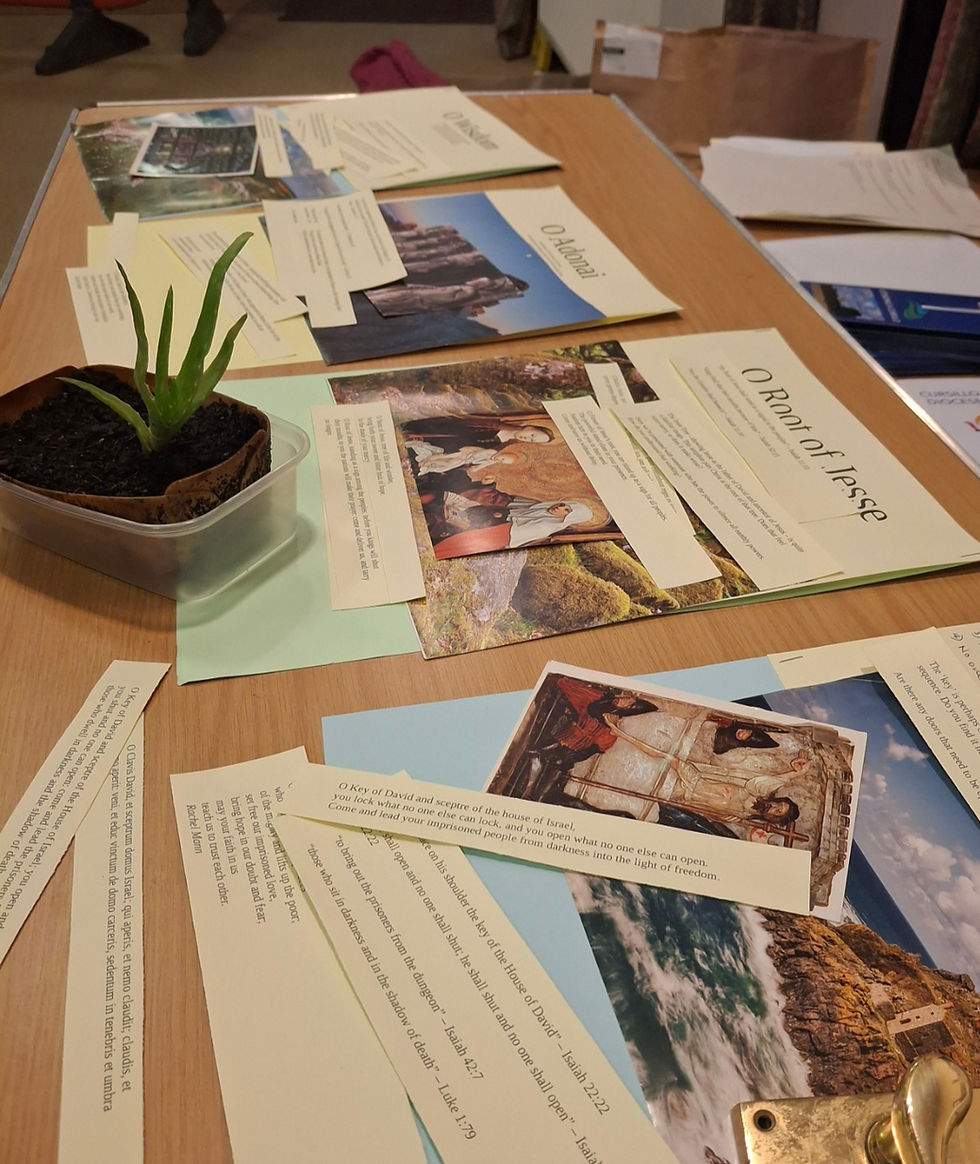
Ely Cursillo's study day O Come Emmanuel: approaching Advent with the O Antiphons took place a couple of weeks ago at St John's church, Waterbeach. After learning about the Church's history of praying together at specific times of day, and how that evolved to mark the seasons, we looked at the seven O Antiphons. We finished the day with a said service of Evening Prayer - restoring the antiphons to their historic place before the Magnificat by singing the Advent hymn O Come, O Come Emmanuel.
We'll continue the journey towards Christmas together with our online Refugio this Saturday - sign up here to receive the Zoom code to join us.
Below, you'll find the introduction and discussion prompts from our study day - but first, here are a few different ways to experience the O Antiphons:
The O Antiphons: how, what, why?
The ractice of praying – together or alone – at specific times of day goes back to the very early Church. There are references to prayer in the morning, at specific times during the daytime, in the evening, and in the middle of the night fairly consistently from the second century. The further we get through history, the more we know about how this daily prayer was practised. By the time Benedict writes his Rule there’s a pretty firm structure in place.
Daily prayer starts out using the psalms; canticles (i.e. biblical songs) get added into these quite early on. At first it’s just songs from the Old Testament, but then texts from the New Testament get added too.
The Magnificat – Mary’s song in Luke’s Gospel – is first mentioned as part of daily prayer in 414. It was originally used in the morning, but at some subsequent point it got moved to Vespers, in the evening.
After the English Reformation, the Book of Common Prayer combined Vespers (evening) and Compline (night) to make Evening Prayer, or Evensong – which has continued in most cathedrals and many churches more or less in that form to this day. It has scripture readings at its centre, which are seen between pillars of psalms and canticles.
Jump all the way back to Italy in the late fourth and early fifth centuries. Here we begin to see the Church marking a special time of preparation before Christmas and Epiphany. It takes a little while for the duration to be settled – there were times when it began as early as 11 November – but in 600 Pope Gregory the Great fixes it at four Sundays before Christmas.
What do we mean by 'preparation'? Originally, people were preparing for baptisms at Epiphany – similar to what we still see with baptisms at the Easter Vigil. These days, we see various different themes being explored through Advent:
preparation for the second coming, and the first coming (tends to be that order)
Four Sundays – patriarchs, prophets, John the Baptist and Mary
Four Last Things – death, judgement, heaven and hell
love, joy, hope and peace
In the 6th century, still in Italy, we find that something gets added for the last week of Advent. Just before the Magnificat at Vespers, we hear a short chant. Every day it’s different. Every day it calls on God the Son to come to us. Every day it stitches together verses and phrases from Scripture into a tiny, gorgeous, patchwork quilt.
If you take the original Latin versions, the first letter of the first word (other than O), and read it backwards, you get ERO CRAS, which means ‘Tomorrow I come’. This might be someone being clever, or it might just be a glorious coincidence.
The Roman Catholics use the O Antiphons, so does the Church of England, so does German Lutheranism. They’re strange, beautiful, dense, unfamiliar, complex, challenging. They call on aspects of Christ that we don’t necessarily spend much time thinking about.
Looking at the O Antiphons together
Below, you'll find the text of the seven O Antiphons, together with the scripture passages from which they're composed and the discussion questions we used. We also looked at contemporary versions, not included here for copyright reasons, from:
Fling Wide the Doors!: an Advent and Christmastime Calendar (Craig M. Mueller)
A Star-Filled Grace: worship and prayer resources for Advent, Christmas and Epiphany (Rachel Mann)
O Sapientia/O Wisdom
O Sapientia, quae ex ore Altissimi prodiisti, attingens a fine usque ad finem,
fortiter suaviterque disponens omnia:
veni ad docendum nos viam prudentiae
O Wisdom, coming forth from the mouth of the Most High, reaching from one end to another mightily and sweetly ordering all things:
come and teach us the way of prudence
Questions
It’s easy to think of God the Son’s involvement with humanity beginning in the stable at Bethlehem, but this antiphon identifies Christ as Wisdom as seen at the opening of the book of Proverbs, making mud pies at the moment of creation. What’s your reaction to that image?
Does the idea of having ‘all things’ ‘mightily and sweetly order[ed]’, and learning ‘the way of prudence’ appeal to you? How well does it work with your understanding of Christ’s work?
References
“I came forth from the mouth of the Most High” – Sirach 24:3
“[Wisdom] reaches mightily from one end of the earth to the other, and she orders all things well” – Wisdom 8:1
“Forsake childishness, and live, and walk by the way of prudence” – Proverbs 9:6
O Adonai
O Adonai, et Dux domus Israel, qui Moysi in igne flammae rubi apparuisti, et ei in Sina legem dedisti: veni ad redimendum nos in brachio extento.
O Adonai, and leader of the House of Israel, who appeared to Moses in the fire of the burning bush, and gave him the law on Sinai: come and redeem us with an outstretched arm.
Questions
This antiphon draws on the stories of Moses’ strange and terrifying encounters with God in the book of Exodus. But in the person of Jesus we meet a human being. How do we reconcile these very different aspects of the Divine?
Both the Latin and the English versions of this antiphon leave the word “Adonai” untranslated from Hebrew. Does the collection of verses that accompanies it here help you to understand what it might mean?
References
“I am the Lord. I appeared to Abraham, Isaac, and Jacob as God Almighty (El Shaddai), but by my name ‘The Lord’ (Adonai) I did not make myself known to them” – Exodus 6: 2-3
“the leader over my people Israel” – 2 Chronicles 6:5
“The angel of the Lord appeared to him in a flame of fire out of a bush” – Exodus 3:2
“These are the commandments that the Lord gave to Moses for the people of Israel on Mount Sinai” – Leviticus 27:34
“I will redeem you with an outstretched arm” – Exodus 6:6
O Radix Jesse/O Root of Jesse
O Radix Jesse, qui stas in signum populorum, super quem continebunt reges os suum, quem gentes deprecabuntur: veni ad liberandum nos, jam noli tardare.
O Root of Jesse, standing as a sign among the peoples; before you kings will shut their mouths, to you the nations will make their prayer: come and deliver us, and tarry no longer.
Questions
The Jesse Tree – showing Jesse as the father of David and ancestor of Jesus – is quite a familiar image. This antiphon puts Christ at the root of that tree. Does that feel topsy-turvy, or does it make sense?
Here we’re presented with someone who has the power to silence all earthly powers. How do you understand that working?
References
“the Root of Jesse shall stand as a signal to the peoples” – Isaiah 11:10
“kings shall shut their mouths because of him” – Isaiah 52:15
“him the Gentiles shall beseech” – Isaiah 11:10
O Clavis David/O Key of David
O Clavis David, et sceptrum domus Israel; qui aperis, et nemo claudit; claudis, et nemo aperit: veni, et educ vinctum de domo carceris, sedentum in tenebris et umbra mortis.
O Key of David and sceptre of the House of Israel; you open and no one can shut; you shut and no one can open: come and lead the prisoners from the prison house, those who dwell in darkness and the shadow of death.
Questions
The ‘key’ is perhaps one of the less familiar names or images for Jesus used in this sequence. Do you find it helpful? Why? Why not?
Are there any doors that need to be opened? Or locked?
References
“I will place on his shoulder the key of the House of David” – Isaiah 22:22
“he shall open and no one shall shut; he shall shut and no one shall open” – Isaiah 22:22
“to bring out the prisoners from the dungeon” – Isaiah 42:7
“those who sit in darkness and in the shadow of death” – Luke 1:79
O Oriens/O Morning Star
O Oriens, splendor lucis aeternae, et sol justitiae: veni, et illumina sedentes in tenebris, et umbra mortis.
O Morning Star, splendour of light eternal and sun of righteousness: come and enlighten those who dwell in darkness and the shadow of death.
Questions
This antiphon draws heavily on the Benedictus, Zechariah’s song in Luke’s Gospel greeting the infant John the Baptist. Perhaps unsurprisingly, that canticle is often used at morning prayer. What is the effect of using this imagery in the evening, and at the darkest time of the year?
There are several possible translations of ‘O Oriens’ – morning star, dawn, dayspring… Which one do you find most helpful?
References
“the dawn from on high” – Luke 1:78
“[Wisdom] is the brightness of eternal light” – Wisdom 7:26
“the sun of righteousness shall rise” – Malachi 4:2
“to give light to those who sit in darkness and in the shadow of death” – Luke 1:79
O Rex Gentium/O King of the Nations
O Rex Gentium, et desideratus earum, lapisque angularis, qui facis utraque unum: veni, et salva hominem, quem de limo formasti.
O King of the nations, and their desire, the cornerstone, making both one: come and save the human race, which you fashioned from clay.
Questions
Cornerstone, keystone, dust and clay: there’s some very concrete and earthy imagery in here. Does that sit at odds with your understanding of a king’s role?
This antiphon speaks to the power of Christ to bring disparate groups together. How or where are you drawn to pray for reconciliation today?
References
“Who would not fear you, O king of the nations?” – Jeremiah 10:7
“the desired of all nations shall come” – Haggai 2:8
“See, I am laying in Zion a foundation stone, a tested stone, a precious cornerstone, a sure foundation” – Isaiah 28:16
“he has made both groups into one” – Ephesians 2:14
“formed man from the dust of the ground” – Genesis 2:7
O Emmanuel
O Emmanuel, Rex et legifer noster, exspectatio Gentium, et Salvator earum: veni ad salvandum nos, Domine, Deus noster.
O Emmanuel, our King and our lawgiver, the hope of the nations, and their Saviour: come and save us, O Lord our God.
Questions
The Incarnation, God being human in the person of Jesus, means that God knows what it’s like to be me. Does that feel comforting? Or does it just give us an impossible ideal to live up to?
“King”, “lawgiver”, “hope”, and “Saviour” – four very different roles, or four very similar ones?
References
“Look, the young woman is with child and shall bear a son, and shall name him Immanuel” – Isaiah 7:14
“The Lord is our lawgiver, the Lord is our king” – Isaiah 33:22
“he shall be the expectation of nations” – Genesis 49:10
“we have our hope set on the living God, who is the Saviour of all people” – 1 Timothy 4:10


Comments